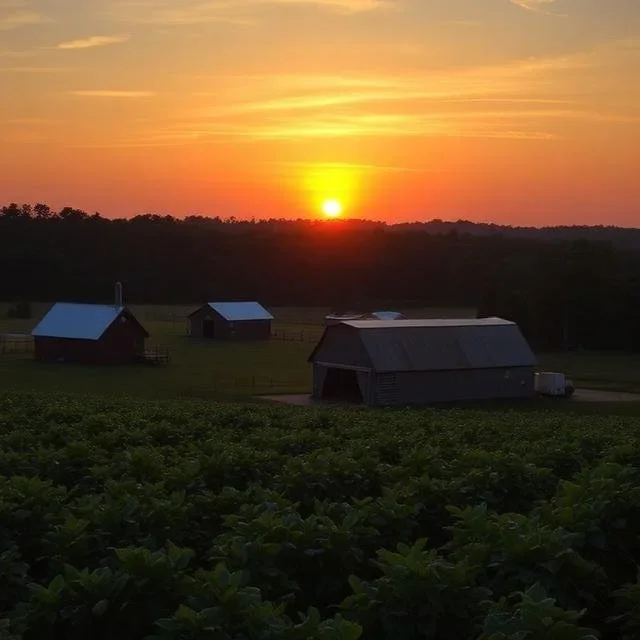
Imagine North Carolina filtered through the soft lens of childhood — midcentury, when the land still spoke in the slow rhythms of tobacco fields and the hush of long summer evenings. This is not the Carolina of statistics or adult ambition, but the one held in a child’s open hands: red clay under bare feet, the sweet‑acrid scent of curing barns drifting on the wind, the distant rumble of a freight train carrying leaves toward Durham or Winston‑Salem. Memory keeps its gentle light here. It does not glare or demand; it glows like late‑afternoon sun through pine woods, illuminating what was ordinary then and has since become precious.
In that light, the world was both vast and intimate. A child might wake to the low murmur of grown‑ups already in the fields, the radio murmuring farm reports and gospel hymns. Breakfast was simple — biscuits, maybe a little molasses — eaten quickly before chores or the long ride to school, or the bus that wound past tobacco warehouses, barns, and dusty crossroads. Afternoons stretched endlessly. There were games of tag among the curing sheds, the thrill of finding a perfect arrowhead in a newly plowed row, the quiet companionship of a dog that knew every path. Evenings brought the porch: adults talking about low prices, weather, and kin, while children listened half‑asleep, the fireflies beginning their slow dance.
This Carolina invites readers to step back into their own midcentury memories — or, if those years belong only to the history books, to learn them through sensory detail rather than dates. For those who lived it, the invitation is quiet recognition: the particular way light fell across a kitchen table, the feel of a mother’s hand smoothing a collar before church, the taste of a tomato still warm from the vine, the first awareness that the world was larger than the county line yet still somehow contained within family and land. For others, it offers a window onto a time when rural Southern life moved at the pace of seasons, when community meant shared labor and shared tables, and when a child’s sense of safety rested in the predictability of ritual — Sunday dinners, harvest celebrations, the careful stacking of wood in the barn.
This gentle light of memory does not erase hardship. It softens the edges of long workdays, of economic uncertainty tied to the crop, of the quiet hierarchies of race and class that shaped every interaction. Yet it insists on the tenderness that co‑existed with those realities: the way a grandparent’s stories made the past feel near, the pride in a well‑tended row, the unexpected joy of a cold watermelon broken open in the shade. In revisiting this child’s Carolina, readers are asked not to romanticize but to remember — or to imagine — how ordinary days could hold such quiet radiance.
This is an invitation more than a portrait. Whether the reader’s own midcentury was spent in the Carolinas or far from them, the light remains the same: soft, persistent, and ready to illuminate whatever personal fragments still glow when called upon. It asks only that we pause long enough to see them again.